
The Time I Prepared a 150-Year-Old Piano for the Set of 1883


Most antique piano restoration projects happen quietly in homes, churches, and workshops. In August of 2021, however, one restoration project led me to the set of the television series 1883, where a 150-year-old Shoninger square grand piano would become part of one of the show's most memorable scenes.
A production company called King Street Productions contacted me and asked if I could tune an antique piano located inside a store in Forney, Texas. They were unusually interested in one thing: they wanted to record me playing the first movement of Beethoven's Moonlight Sonata.

At the time, they didn't tell me much about the project. I simply assumed they needed a period-correct piano and wanted to hear what it sounded like.
When I arrived, I discovered an 1870s Shoninger square grand piano. The instrument was well over a century old and in need of considerably more than a simple tuning. The pedal system was barely functioning, and several mechanical issues would prevent it from being used reliably.
The production team wasn't interested in a complete restoration at that point. They simply needed the piano functioning well enough to create a recording. After making temporary repairs—including a rather creative use of duct tape to keep parts of the pedal system operational—I spent several hours tuning and preparing the instrument.
Once it was ready, I recorded the first movement of Moonlight Sonata for them. I later learned that the recording would be reviewed by Taylor Sheridan's team for use in a new television series called 1883.
At the time, I had never even heard of Yellowstone.
Before leaving, I provided the production team with a detailed list of repairs the piano would eventually need if they intended to use it on camera.
I didn't hear anything more for several weeks.
Then in October, the phone rang again.
The piano was heading to set.

The production team informed me that filming would begin within days and that the remaining repairs would need to be completed on location. They booked me into a hotel in Weatherford, Texas and provided a box truck that would serve as my temporary workshop.

For three days, I worked on the piano almost nonstop.
I repaired the pedal system properly, regulated the action, repaired damper issues, cleaned and polished the instrument, cleaned the strings, restored the appearance of the keytops, and prepared the piano for close-up filming. The camera would see details that most audiences never consciously notice, so every part of the instrument had to look and function correctly.

Over the course of those four days, I tuned the piano approximately twenty-five times.
Twelve of those tunings happened on the day of filming alone.
Because the piano was constantly being moved between my workshop truck and the filming location, the instrument required constant attention.


On my third day, I met actress Isabel May, who portrayed Elsa Dutton. Since square grand pianos behave differently than modern instruments, I spent time explaining some of the piano's unique characteristics and helping her become comfortable with the instrument she would soon be playing on camera.
The morning of filming brought an unexpected change.

For the first few days I had simply been the piano technician working in the background. Suddenly everyone seemed to realize how critical the piano was to the scene. Production assistants made sure I had breakfast, coffee, tools, and anything else I needed. Crew members asked for my opinions on sound, microphone placement, and even how best to showcase the instrument's interior mechanics for several close-up shots.
During filming I spent much of my time inside the tent with Taylor Sheridan and the production crew, monitoring the instrument and waiting for the next adjustment. Between takes I would listen through a headset, evaluate what I was hearing, and make adjustments whenever necessary.

The cast and crew completed approximately thirty takes of the scene.

One detail that still makes me smile is that I had been placed on standby as a potential performance double. If the production ultimately felt they needed a stronger piano performance, I was prepared to sign the necessary paperwork and perform the piece myself.
Fortunately for the production—and perhaps unfortunately for my brief acting ambitions—Isabel May did an excellent job.

When Episode 4 finally aired, there was the piano.
A 150-year-old Shoninger square grand that had traveled from an antique store in Forney to the set of one of television's most successful western dramas.
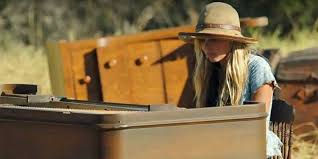
I don't know where the piano is today. I never owned it, and after filming wrapped it continued on its own journey.
But the experience remains one of the most memorable projects of my career.
It was a reminder that every piano has a story.
Some spend generations in family homes. Some serve faithfully in churches and schools. And occasionally, a piano built in the 1870s finds itself under the lights of a Hollywood production.
As piano technicians, we are not simply maintaining instruments. We are preserving pieces of history and helping their stories continue for the next generation.
And sometimes, those stories end up on television.
Stephen Willett is the owner of Moonlight Piano Tuning, serving Dallas, Rockwall, Greenville, Sulphur Springs, and surrounding North Texas communities with piano tuning, repair, restoration, and player piano services.


Comments